https://pmc.ncbi.nlm.nih.gov/articles/PMC1121241/
Biological and social systems are inherently complex, so it is hardly surprising that few if any human illnesses can be said to have a single “cause” or “cure.”1 This article applies the principles introduced in the introductory article in this series2 to three specific clinical areas: the control of blood glucose levels in diabetes, the management of diagnostic uncertainty, and health promotion.
A complex adaptive system is a collection of individual agents with freedom to act in ways that are not always totally predictable, and whose actions are interconnected so that the action of one part changes the context for other agents.2 In relation to human health and illness there are several levels of such systems.
For all these reasons neither illness nor human behaviour is predictable and neither can safely be “modelled” in a simple cause and effect system.3 The human body is not a machine and its malfunctioning cannot be adequately analysed by breaking the system down into its component parts and considering each in isolation. Despite this fact, cause and effect modelling underpins much of the problem solving we attempt in clinical encounters; this perhaps explains why we so often fail.4
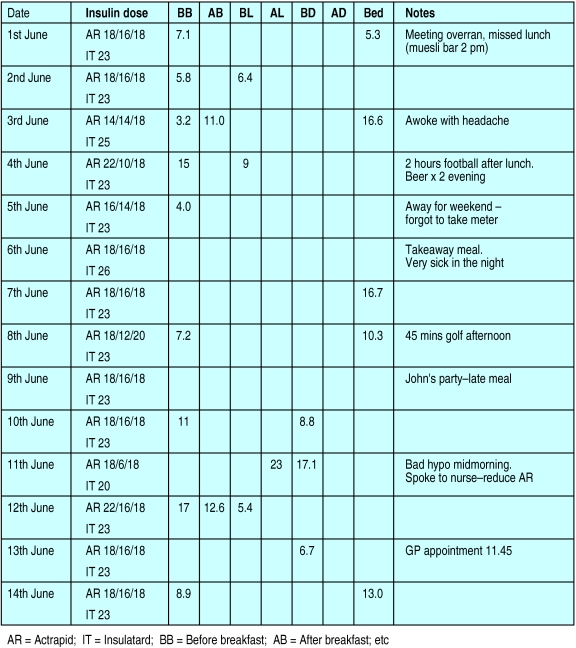
Figure 1 shows a page from the diary of a man with type 1 diabetes. It includes biomedical details (blood glucose concentrations, insulin doses given), physiological inputs (meals and snacks) and outputs (exercise), social events (a party), pathological states (vomiting), and clinical encounters with health professionals (an appointment with his general practitioner and a phone call to the nurse). It gives a flavour of the complex interplay between physiology and behaviour and of the huge distance between the health professional in the clinic and the patient's experience of day to day control of his blood glucose. Even though this record is more detailed than most, it is still a woefully incomplete source of data from which to attempt to predict the course of the patient's blood glucose level and to advise on insulin dosage or dietary modification.